
Commit to Students: School Board Candidate Survey
I submitted the following responses on March 18th to the request I received from Commit to Students.
Unless otherwise noted (like masking email addresses), what follows is what I submitted to them, word for word. Any question answered with a Yes or No were questions where I was given only those as choices without any opportunity to provide any clarifying points. The same is true of the ranking question. I believe some of these questions deserve the opportunity to add additional context.
Name: Dave Jimenez
Email: (Deleted to avoid SPAM)
Phone Number: (214) 307-2113
School District: Carrollton-Farmers Branch ISD
What inspired you to run for your local school board in the 2026 election?
I’m running because I believe this district deserves board members who bring professional rigor to the decisions that affect our kids, our teachers, and our taxpayers.
I believe the role of a trustee is to primarily support and represent teachers and faculty.
Yes
I believe trustees should be in constant communication with superintendents.
Yes
I believe student outcomes should factor into a teacher's compensation level.
Yes
I believe a superintendent's evaluation should include clear metrics tied to student outcomes.
Yes
Community input is valuable, but I believe decisions must ultimately be grounded in data of what works for students.
Yes
As a trustee, I believe my role is strictly limited to governance instead of management and day-to-day operations of the district.
Yes
I believe closing student achievement gaps should be a central responsibility of the school board.
Yes
When selecting a new superintendent, I believe demonstrated student outcomes in their prior roles should be a primary consideration.
Yes
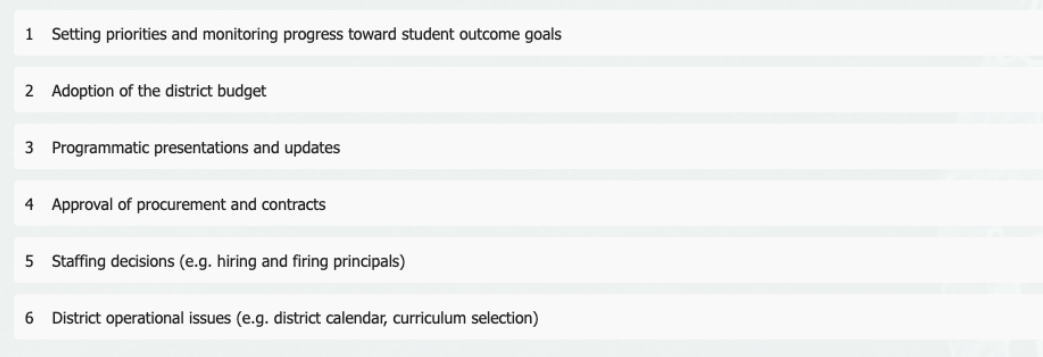
Rank Priorities: Please rank the following from highest to lowest priority based on where you believe a school board should spend the majority of its meeting time and attention.
A middle school’s enrollment has steadily declined over the past seven years, dropping from approximately 700 students to just 200. The school now operates far below capacity in a building designed for 1,000 students, costing the district millions of dollars annually in lost per-pupil revenue and ongoing maintenance and operations.
District leadership has proposed a strategy to consolidate this campus with a nearby school that has higher enrollment and to sell the vacated building to generate revenue in response to declining enrollment. The campus proposed for closure is rated a “D” under the state A–F accountability system, while the receiving campus is rated a “B.”
The proposal will be presented to the full board at a public meeting in two weeks. In advance of that meeting, you begin receiving a high volume of communications from families, alumni, and community leaders at both campuses, many of whom are urging you to publicly oppose the proposal.
As a school board member, what decision would you make and what factors contributed to your decision making?
I support the consolidation. A campus that has dropped from 1,000 to 700 students in a building designed for 1,200 is operating at approximately 58% capacity. That's not a school being served well. That's a school where resources are being consumed by a building instead of invested in students. The district is paying millions annually in maintenance and operations on a facility that is approximately 40% empty while per-pupil revenue declines with every student who leaves. That math doesn't stabilize on its own. It gets worse every year.
The academic data reinforces the decision. The closing campus carries a D rating. The receiving campus carries a B. Consolidation doesn't just save money, it moves 200 students into a stronger academic environment with more resources, more program offerings, and a larger peer community.
I understand the community response and I take it seriously. A school is more than a building. It's an anchor for families and neighborhoods. It IS what defines our community. But my job as a trustee is not to make the most popular decision. It's to make the right one based on the data, and then be transparent with the community about why.
Before voting yes, I'd want to see a detailed transition plan addressing transportation, extracurricular continuity, and staffing at the receiving campus. I'd want a clear timeline for the building sale with projected revenue and its designated use. I'd want a communication plan that goes beyond a single public meeting. Families at both campuses deserve direct engagement, not just a presentation. I'd want academic support resources for transitioning students to ensure the move strengthens rather than disrupts their learning.
Declining enrollment is a structural reality driven by many factors. Many of these factors are outside of the district's direct control. Things like declining birth rates and legislation passed by Austin are not within the district's direct control, but they are realities that we face. Significant ones. The board's responsibility is to manage it proactively.
District data has consistently shown that academic progress across grades and subjects begins to stall in sixth grade. In response, the Board led a year-long process to revise its four student outcome goals and added a fifth goal focused specifically on improving middle school achievement.
The following school year, at the superintendent’s recommendation, the Board approved a $40 million investment in a new middle school program aligned to these goals. The program was piloted in several middle schools and has completed its first year of implementation.
Early results from the pilot show mixed progress, and it is unclear whether the program will improve student outcomes quickly enough to meet the Board’s stated goals. Three Board members, all of whom originally voted against hiring this superintendent last year, have begun publicly expressing concern and are discussing whether to terminate the superintendent’s contract, citing a lack of confidence in her ability to improve student achievement.
As a school board member, what are your next steps and why?
Terminating the superintendent over one year of mixed pilot data would be reckless governance. The fact that the three members pushing for it are the same three who voted against hiring her suggests this is about politics, not performance. I want to be candid about something. We have allowed too much politics to impact what happens to our kids and the folks that serve them in the district every day... their teachers, support staff, and administrators on campuses.
The board set five student outcome goals through a year-long deliberative process. The board approved a $40 million investment aligned to those goals. The program has completed one year of a pilot. One year of mixed results is not failure. Not yet. It's implementation. Any serious organizational transformation shows uneven early results. The question isn't whether year one was perfect. It's whether the trend lines, implementation fidelity, and leading indicators support continued investment.
My next steps: First, request a comprehensive data review from administration. What does "mixed" actually mean? Which schools showed progress? Which didn't? What were the implementation variables that led to these findings... staffing gaps, resource shortfalls, fidelity issues? You cannot make a $40 million decision based on a one-sentence characterization of results.
Second, insist on a formal evaluation framework with clear benchmarks and timelines. If the board approved this program and this superintendent, it owes her a defined runway with measurable milestones. If year two or year three data shows the program isn't working, that's a different conversation grounded in evidence. Right now, we don't have that.
Third, address the three board members directly and privately. Public calls to terminate a superintendent, especially from a faction that opposed the hire in the first place, damage the district's ability to recruit and retain leadership. It signals to every future candidate that this board will undercut you before your initiatives produce results. That's a governance failure that harms students far more than a mixed pilot year.
The board's job is to set goals, fund strategies, evaluate results on a reasonable timeline, and hold leadership accountable against clear metrics. It is not to panic after twelve months and blow up a multimillion-dollar initiative for political reasons.
Two years ago, voters approved a $3.5 billion school facilities bond that allocated funding to specific construction and renovation projects across the district. More recently, the district completed a comprehensive facilities assessment conducted by an external consultant. The assessment identified five campuses in one area of the district with significant deferred maintenance and facility conditions that hinder the provision of safe and effective learning environments. These same campuses also rank among the lowest in the district in terms of academic achievement.
In response, district administration developed a proposal to allocate $50 million to address the most urgent needs at these five campuses. The superintendent informs the Board that the only way to fund this work in the near term would be to vote at the next board meeting to reallocate funds from some previously approved bond projects. The majority of the cuts will be in your neighborhood feeder pattern and you are hearing concerns.
As a school board member, how do you respond?
This is a test of whether a trustee can put district-wide student needs above personal and neighborhood interests. The answer is yes, but with conditions.
Five campuses with deferred maintenance severe enough to hinder safe and effective learning environments is not a hypothetical concern. It's a liability to students, to staff, and to the district. It is likely not a coincidence that these same campuses also rank among the lowest academically. Facility conditions affect student outcomes. Research consistently shows that students in deteriorating buildings perform worse, and teachers in those environments leave at higher rates. If the facilities assessment was conducted by an independent consultant and the data supports the urgency, the board has a responsibility to act.
The fact that the cuts fall in my feeder pattern makes this harder personally but doesn't change the analysis or the calculus. Voters approved a bond to improve facilities across the district. They trusted the board to allocate those dollars where they're needed most. If the most urgent needs are at five campuses on the other side of town, that's where the money should go. A trustee who redirects funds to protect their own neighborhood at the expense of students in unsafe buildings has failed the fundamental obligation of the role.
That said, I would insist on several things before voting. First, full transparency about which bond projects are being delayed or reduced, what the impact will be on those communities, and what the revised timeline looks like. The families in my feeder pattern who voted for that bond deserve to know exactly what's changing and why. Second, I'd want assurance that the $50 million addresses the most critical safety and learning-environment deficiencies, not less critical upgrades like cosmetic ones, and that there's a facilities plan to eventually complete the deferred projects in my area. Third, I'd want public communication that doesn't sugarcoat the trade-off. Tell the community: we have five schools where conditions are unacceptable, here's the data, and here's what we're doing about it.
The hardest votes in governance are the ones where doing the right thing for the district costs you something personally. That's exactly when voters need to know what kind of trustee they elected.
Several parents from an elementary school in your district contacted you expressing strong concerns about a recent decision made by the school’s principal to reassign teachers and adjust class sizes mid-year. Parents report that their children are upset by the changes, and some believe the decision was poorly communicated and disruptive to learning.
A small but vocal group of parents begins attending board meetings, emailing trustees, and posting on social media demanding that the school board intervene and reverse the principal’s decision. They ask you directly to step in and “hold the principal accountable,” arguing that the board has a responsibility to protect students and families from poor leadership at the campus level.
District administration indicates that the decision was made in response to staffing constraints and enrollment shifts, and that it falls within the principal’s authority under district policy. They also note that they are monitoring the situation and supporting the principal in improving communication with families.
As a school board member, how would you respond?
I would not intervene to reverse the principal's decision, and I would be honest with the parents about why.
A principal adjusting staffing and class sizes in response to enrollment shifts and staffing constraints is an operational decision that falls squarely within campus-level management authority. The district has confirmed this is within policy. The board's role is governance. Governance includes setting vision, approving budgets, hiring and evaluating the superintendent, and holding administration accountable for student outcomes. It is not directing campus operations or overriding a principal's staffing decisions. When trustees cross that line, they undermine the entire leadership structure the district depends on to function.
That said, I would not dismiss these parents either. Their concerns are legitimate and deserve a serious response. It's just not the response they're asking for.
Here's what I would do. First, I'd listen. I would meet with or respond to every parent who contacted me. They need to know their trustee takes them seriously, even when the answer isn't what they want to hear. I'd hear their specific concerns. Is this about the disruption itself, about how it was communicated, or about a deeper lack of trust in campus leadership? Those are different problems with different solutions.
Second, I'd ensure the superintendent is aware of the scope of parent concern. The board doesn't manage principals, but it does evaluate the superintendent, and the superintendent is responsible for ensuring campus leaders communicate effectively with families. If the administration is already monitoring the situation and supporting improved communication, that's the system working. If the communication failures persist, that becomes a pattern the superintendent needs to address and a data point in the superintendent's evaluation.
Third, I'd be transparent with the parents about the board's role. Not with a bureaucratic brush-off, but with a direct explanation: "I hear you, I've raised this with the superintendent, and the administration is addressing the communication concerns. If you're not seeing improvement, keep telling me. But the board stepping in to reverse a principal's staffing decision would set a precedent that makes this district harder to lead, and that ultimately hurts your kids."
The hardest part of this role is telling engaged, passionate parents the truth rather than what they want to hear and doing it in a way that keeps them engaged rather than alienated. My entire ethos is honestly, candor, and respect and I would not change that in this role.
