
What Vouchers Will Cost CFBISD
A district-specific analysis of Texas Senate Bill 2 and the Florida precedent
THE SHORT VERSION
Texas passed the largest day-one school choice program in the country at the end of the 2025 Legislative Session. The first round of voucher application data is in. Florida, which passed a nearly identical law in 2023, has three years of real-world results we can study. I did that and here is what it all means for CFBISD, and other districts throughout our state.
We closed four schools in March 2025 before a single voucher dollar left the state. When the board made that decision, the district was projecting a $19 million shortfall. The audited result for fiscal year 2024-25 came in at a $14.6 million General Fund deficit per CFBISD's own Annual Comprehensive Financial Report. That's the real number. The school consolidation (Central, Furneaux, McCoy Elementary Schools and Long Middle School) reduced 2,300 empty seats out of approximately 9,800 the district had identified across its campuses. The Texas Legislature froze the basic allotment from 2019 through 2024 and raised it by $55 in 2025, the first increase in six years while inflation ate into every dollar.
CFBISD is a recapture district. We sent $7.8 million back to the state under Chapter 49, per the Texas Tribune Schools Explorer. When students leave, local tax revenue doesn't drop. Our fixed property tax base still generates the same dollars. But our formula entitlement shrinks, and the difference gets swept into a larger recapture payment to Austin. We absorb the full loss.
The state is subsidizing families who never used public schools. 274,183 Texas families applied for TEFA vouchers in the first window. According to analysis by the Texas Center for Voucher Transparency, 76% of voucher applicants are not currently enrolled in public schools. That means that 76% of the $1 Billion allocated by the legislature is a subsidy, pure and simple. The opposite of how this was sold. Fewer than 1% of Texas public school families applied for the program. The voucher program isn't a response to public school families fleeing the system. It's primarily paying families who never chose public schools in the first place.
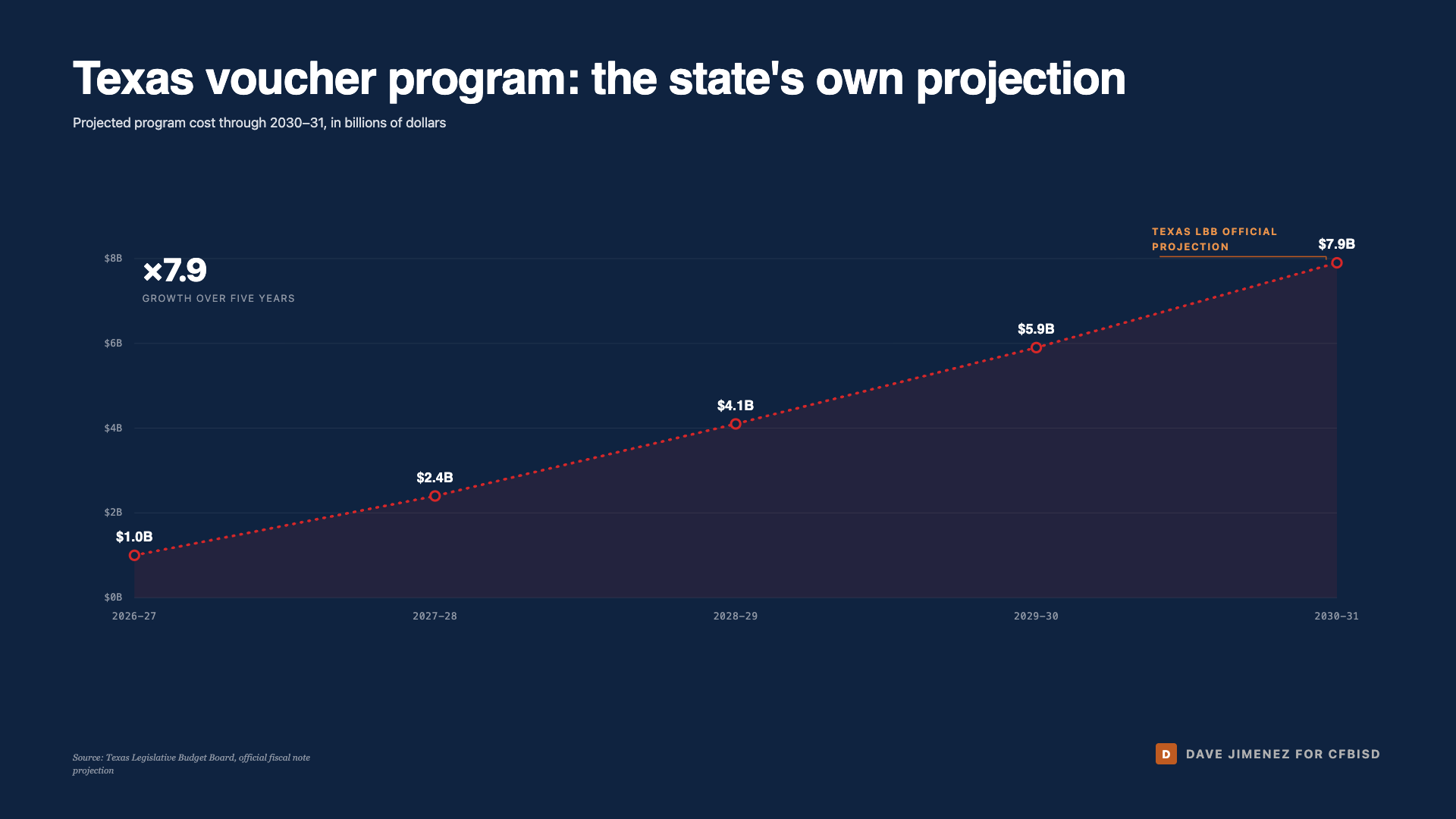
The financial trajectory is steep. The Texas Legislative Budget Board projects voucher costs could reach $7.9 billion by 2030-31. That money comes from the same general revenue pool CFBISD's recapture payments flow into.
Florida's experience tells us what comes next. Florida passed HB 1 in 2023 making vouchers universal. Florida's State Education Estimating Conference projects public school enrollment will decline by 66,000 students over five years, while voucher participation grows by 240,000. According to Step Up for Students (Florida's voucher administrator), about 69% of students new to the voucher program were already enrolled in private schools. Voucher spending in Florida grew from $1.4 billion in 2022-23 to $3.9 billion in 2024-25.
The accountability gap is permanent. Public schools take STAAR, get A-F ratings, face state intervention for failure. Private schools taking TEFA voucher money report to the Comptroller, not TEA, take a private test, and don't publish school-level results. The voucher law only requires reporting to the legislature after five years of the program, leaving taxpayers with limited oversight during the early stage of the nation's largest voucher program.
WHAT THE EARLY TEXAS DATA TELLS US
The early data from the Texas Center for Voucher Transparency, drawing from Texas Comptroller of Public Accounts records, makes one thing clear: this program is not what it was sold as.
It is not a lifeline for public school students seeking better options. Of 274,183 total applications, only about 24% came from families with students currently enrolled in Texas public or charter schools. Of the roughly 5.5 million students in Texas public schools statewide, fewer than 1% of families applied for vouchers. The narrative that vouchers are responding to mass dissatisfaction with public education is not supported by the application data.
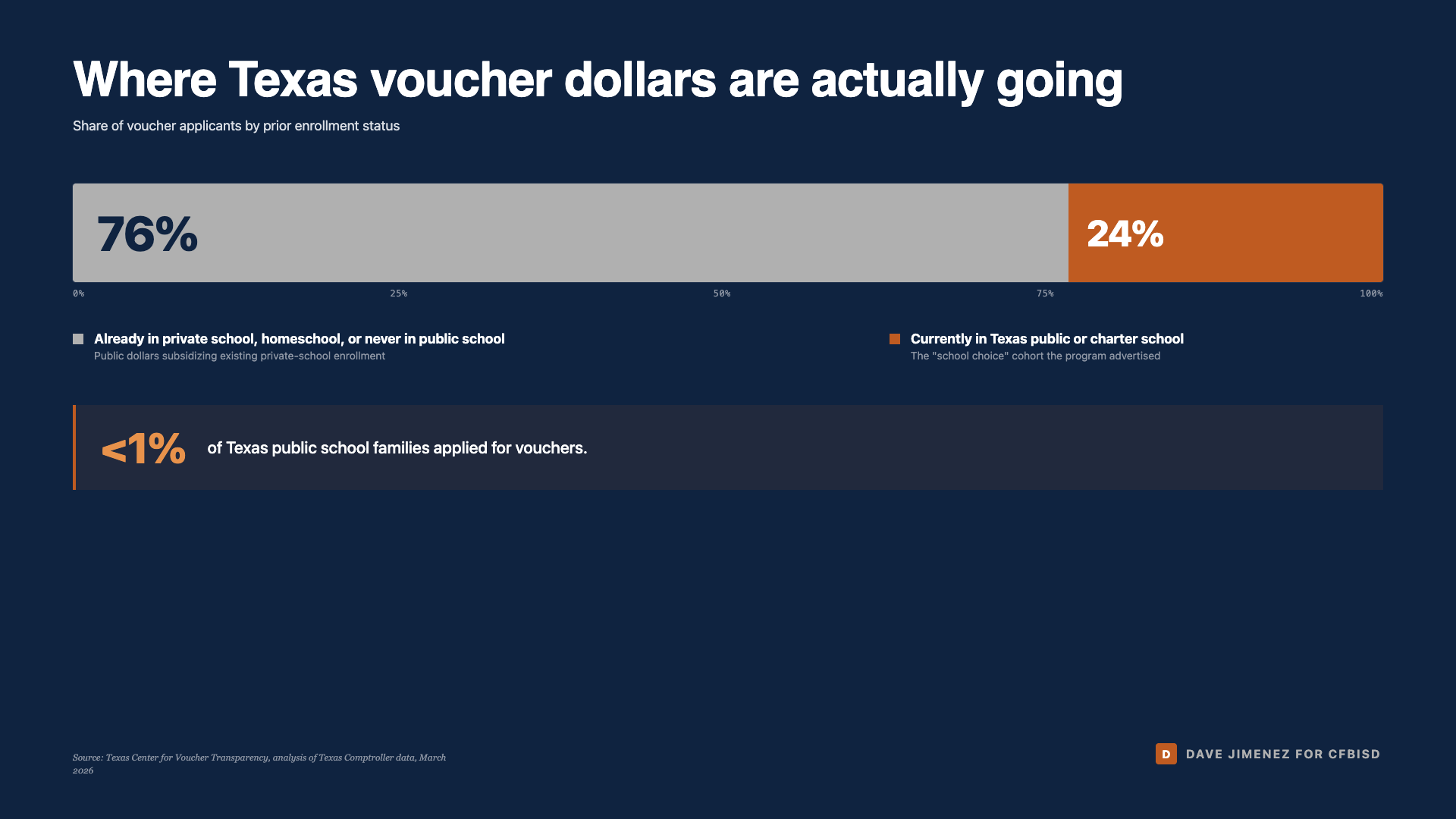
It is largely a tuition subsidy for families who never used public schools. 76% of applicants come from families whose children already attend private schools, are homeschooled, or never attended public school. The Texas program is functioning the same way Florida's program functioned: most participants were not in public school to begin with.
Geographic access is highly uneven. More than 60% of Texas's 254 counties currently have no schools accepting vouchers. Approximately 70% of participating private schools are concentrated in the Dallas-Fort Worth, Houston, San Antonio, and Austin urban areas. According to Texas Observer reporting, more than 180 of Texas's 254 counties have no participating elementary, junior, or senior high schools. Rural Texans are paying taxes that fund a program their families largely cannot access.
The "school choice" framing obscures who actually has the choice. Private schools are not required to accept any student who shows up with a voucher. They can reject applicants based on academic record, behavior, faith, or special education needs. According to Texas Observer analysis of the 291 participating schools that offer education beyond kindergarten:
More than 90% are affiliated with or owned by a religious or faith-based group
More than 100 require or prioritize students of the same faith
60 have written policies that discriminate against LGBTQ+ students
The students the program claims to prioritize are often unable to access it. Approximately one-third of participating private schools charge tuition exceeding the $10,474 voucher amount, putting access out of reach for lower-income families who would have to front the difference. Fewer than a dozen participating schools indicated they offer special education services, despite the program's stated priority for students with disabilities. Students with disabilities can receive up to $30,000 in voucher funds, but private schools accepting that money are not required to actually provide the special education services those students need under federal law.
The financial scope is staggering. The Legislative Budget Board projects voucher costs could reach $7.9 billion by 2030-31. The program is the largest day-one school choice initiative in the nation. The voucher law requires reporting to the legislature only after five years of operation, meaning Texas taxpayers will fund this program at multi-billion-dollar scale for half a decade before the legislature receives a formal accounting.
FLORIDA IS NOT A WARNING.
IT'S A PREVIEW.
Florida passed HB 1 in March 2023. It removed income limits on their existing voucher program, making it universal, just like Texas's TEFA. Three years in, the data tells us exactly what to expect.
The state-level numbers tell the story
Florida's State Education Estimating Conference (April 11, 2025) projects public school enrollment will decline by 66,000 students over five years. Voucher participation is projected to grow by 240,000 students over the same period. The Florida Department of Education reports that 1.4 million Florida students now attend a school of choice, with more than 500,000 attending a private school on a voucher and 155,000 reportedly homeschooled.
District-level enrollment loss is hitting Florida's largest districts hard
Per FLDOE Student Enrollment data (as compiled in OpenData's analysis at labs.tryopendata.ai), between 2018-19 and 2025-26, Florida's six largest districts experienced significant enrollment declines: Broward lost approximately 35,000 students, Miami-Dade lost approximately 29,000, Palm Beach lost approximately 9,000, Orange lost approximately 8,000, Hillsborough lost approximately 7,000, and Duval lost approximately 3,000. Orange County alone lost 7,000 students this fall, attributed to a combination of vouchers, declining birth rates, and immigration enforcement concerns.
The financial impact on Florida public schools is documented
Florida voucher spending grew from $1.4 billion in 2022-23 to $3.9 billion in 2024-25 (per Florida Policy Institute analysis), with $2.8 billion through Family Empowerment Scholarships and $1.1 billion through Florida Tax Credit Scholarships. Projected 2025-26 spending is approximately $5 billion. Vouchers now constitute 24.2 percent of total Florida Education Finance Program spending. Florida ranks 50th nationally in average teacher pay at $54,875.
The accountability data is harder to find by design
Florida investigations have documented voucher funds being misused for things like Disney vacations. Arizona has documented voucher funds spent on LEGOs. The Texas Comptroller's office denied requests during the rulemaking process for participating private schools to disclose information including school-level performance data, available spots by grade level, graduation rates, and money recouped for ineligible expenses. Iowa, for comparison, requires voucher students to take the same state assessment as public school students. Texas chose not to require this.
WHAT THIS MEANS FOR CFBISD
Let me put some directional numbers on this. These are estimates based on Florida's actual statewide impact scaled to CFBISD's size. They're directional, not precise, and the actual numbers will depend on how many Texas families take up vouchers.
Current CFBISD enrollment: 24,165 students per the 2024-2025 ACFR, down from a recent peak of 25,796 in 2016.
Florida's projected statewide enrollment decline through 2030: Approximately 2.5% (66,000 of nearly 3 million students).
If CFBISD experiences a similar decline beyond current projections: Approximately 600 additional students lost by 2030 attributable to voucher uptake.
Revenue impact estimate: Public school per-student funding in Texas runs approximately $11,487 per CFBISD's reported per-student funding from the Texas Tribune Schools Explorer. The formula entitlement loss per departing student depends on the specific funding mix. Even using conservative assumptions, voucher-driven enrollment loss could compound CFBISD's existing deficit by several million dollars annually by 2030.
Stacked on our current $14.6M audited deficit: Without offsetting revenue increases or further cost reductions, voucher-driven losses could push CFBISD toward a structural deficit in the high teens or low twenties of millions annually.
The kindergarten cliff is the scariest part of the Florida data. Younger cohorts that never enter public school don't show up in current-year enrollment loss numbers. They show up over the next 13 years, every year, as smaller and smaller classes roll forward. CFBISD's own demographer report (December 2024) already showed three consecutive years of declining attendance in kindergarten, first, fourth, and ninth grade.
And this is on top of enrollment decline already happening. CFBISD's demographer report projects continued enrollment decline based on birth rates, housing costs, and charter school competition alone. Vouchers accelerate a trend that was already underway.
THE RECAPTURE LOOP
This is the part that voters hear least about. CFBISD is a Chapter 49 recapture district. That means we're classified as "property wealthy" because our taxable property value per student is above the state threshold. Per the Texas Tribune Schools Explorer, in the most recent reported year we collected $243.8M in local property taxes and sent $7.8M back to Austin for redistribution to property-poor districts.
Here's what happens when our enrollment drops:
Local property tax collection stays roughly the same. Property values don't fall when kids leave.
Our formula entitlement shrinks because entitlement is based on enrollment.
The gap between what we collect and what we're entitled to keep grows.
That gap flows to the state as increased recapture.
Recaptured dollars enter the Foundation School Fund and general revenue.
General revenue is the same pool that funds TEFA vouchers.
So the chain looks like this: enrollment drops → entitlement drops → recapture goes up → recaptured dollars feed the voucher program → voucher program funds the private schools pulling kids out of public schools → enrollment drops again.
CFBISD taxpayers are unknowingly helping fund the system that's dismantling their own district. Every time we send a dollar to the state, we don't know if it ends up funding a classroom in a property-poor district, a state budget surplus, or a voucher for a family that never used public schools.
THE ACCOUNTABILITY GAP IS BUILT INTO THE DESIGN
Let me be clear about what Texas created with TEFA.
Public schools:
Take STAAR, EOC, and other state-mandated assessments
Receive A-F letter grade ratings from TEA
Publish school-level performance data annually
Face state intervention, takeover, or closure for chronic underperformance
Subject to TPIA (Texas Public Information Act) requests
Board members are elected and subject to open meetings laws
Financial reporting is public and auditable
Required to accept all students, including those with disabilities, English learners, and those with disciplinary records
Required to provide special education services under federal law
TEFA voucher-funded private schools:
Take a "nationally norm-referenced assessment" of the school's choice
Report to the Comptroller, not TEA
Not required to publish school-level results
No letter grade ratings
No state intervention or takeover authority
Not subject to TPIA
Not subject to open meetings laws
Not subject to the same financial reporting requirements
Permitted to set admission requirements and deny students for any reason including faith, academic record, behavior, or disability
Not required to follow federal special education laws even when receiving up to $30,000 per disabled student
No required reporting to the legislature for the first five years of the program
Iowa, for comparison, requires voucher students to take the same state assessment as public school students. It's possible. Texas chose not to require it.
The consequence is asymmetric accountability. Public schools are graded on outcomes, punished for failure, and defunded for underperformance. Private schools receiving the same public dollars face none of that. The system being defunded is the only one the public can see. The system being funded is invisible to the public.
This should offend conservatives as much as it offends public school advocates. Conservatives built their case for school choice on the premise that competition produces better outcomes. If competition is going to produce better outcomes, someone has to be able to measure who's doing better. Texas chose not to create that scoreboard. The claim that vouchers will improve outcomes is being made without a way to verify it.
ONE NOTE ON CFBISD'S OWN FISCAL DISCIPLINE
It's important to be honest about this: CFBISD is not a financially mismanaged district at the operational level. The district has earned an "A" or Superior Achievement rating in TEA's School FIRST Financial Integrity Rating System every year since 2002-03, including for 2024-25. The General Fund decrease of $14.6 million in 2024-25 is real, but the district maintains an unassigned General Fund balance of $89.8 million (29.2% of expenditures), which is a healthy reserve.
The argument here is not that the district is wasting money. The argument is that the state funding structure, the recapture system, and now vouchers are creating a systemic problem that no amount of operational discipline can fix. A board that demands transparency, asks hard questions, and refuses to rubber-stamp administration recommendations is part of the solution. So is a state legislature that funds public education at levels matching inflation. The district has done much of what it can. Austin has not.
WHAT CAN WE ACTUALLY DO
The biggest lever is the November 2026 state elections. The Texas Legislature built this funding system. The Governor's mansion and the legislature write the rules, control TEA, and set the per-student allotment. Local school board races matter, but the money decisions get made in Austin.
Stop marching on CFBISD. Start marching at the Capitol. The CFBISD board didn't cause a $14.6M audited deficit. State funding formulas, a frozen basic allotment, and the structure of the voucher program did. Protesting school closures at district HQ is yelling at the people on the receiving end of the math.
Demand the state raise the basic allotment. The basic allotment was frozen at $6,160 from 2019 through 2024, with a $55 increase taking it to $6,215 in 2025. That's the first increase in six years. Inflation has eaten roughly 20% of the allotment's purchasing power. If the state had increased the allotment to keep pace with inflation, districts like CFBISD wouldn't be closing schools. The state chose to sit on a multi-billion-dollar surplus instead, and is now using it to fund vouchers.
Demand equal data transparency. If billions in taxpayer dollars are flowing to private schools through TEFA, those schools should publish their test results at the school level. The same transparency standard that applies to CFBISD should apply to every school receiving public money. This should be an easy argument to make to a conservative legislature that says it believes in accountability.
Support independent transparency efforts. Our Schools Our Democracy launched the Texas Center for Voucher Transparency (TCVT) and a Voucher Watchdog Reporting Portal that allows Texans to confidentially report potential misuse of voucher funds. When the state declines to provide oversight, civil society has to step in.
Know who represents us in Austin. CFBISD is split across multiple Texas legislative districts. Voters should look up their specific representatives at fyi.capitol.texas.gov by entering their home address. These are the people who voted on SB 2 and control future education funding decisions. Their votes are public. Their offices take constituent calls.
Organized advocacy matters. Raise Your Hand Texas (founded by Charles Butt of H-E-B) has been running workshops and candidate forums across the state. Friends of Texas Public Schools (FOTPS) tracks data and advocates for public education. They have the infrastructure to help parents and community members advocate at the state level effectively.
Local elections still count. A well-governed local board can't replace lost state funding. But it can manage what remains with discipline, demand transparency, push back on bad decisions, and make sure every dollar spent in CFBISD is spent on students. That's the work I'm running to do.
SOURCES
CFBISD financial data:
CFBISD 2024-2025 Annual Comprehensive Financial Report (ACFR), audited by Whitley Penn LLP. Available at cfbisd.edu/departments/business-support-services
2024-2025 General Fund decrease (operating deficit): $14,629,522
Total General Fund expenditures: $307,028,019
Unassigned General Fund balance: $89,767,332 (29.2% of expenditures)
Student enrollment (PEIMS snapshot): 24,165
Enrollment history: 25,796 (2016) → 25,611 (2020) → 24,165 (2025)
School FIRST Superior Achievement rating since 2002-03, including 2024-25
Texas Tribune Schools Explorer, CFBISD funding profile (schools.texastribune.org/districts/carrollton-farmers-branch-isd/funding/)
CFBISD news release on Trustee approval of school consolidation, March 6, 2025: 2,300 empty seats reduced through consolidation
CFBISD "Planning for Future Success" page documenting 9,800 empty seats from October 2024 demographer report
Star Local Media, "Demographer reports CFBISD enrollment decline due to charter schools, housing trends," December 17, 2024
Texas TEFA / SB 2 sources:
Texas Education Freedom Accounts official program site: educationfreedom.texas.gov
Texas Comptroller's Office Preliminary Student Application Fact Sheet: 274,183 total applications
Friends of Texas Public Schools, "What Early Voucher Data is Telling Us" (April 2026): 76% of voucher applicants not currently enrolled in public schools; fewer than 1% of public school families applied
Texas Center for Voucher Transparency (Our Schools Our Democracy): independent analysis of Texas Comptroller data
Texas AFT, "TCVT Report: Voucher application data raises new questions about who the program really serves" (March 2026)
Texas Observer investigation of 291 participating private schools: 90%+ religious affiliation, 100+ schools require or prioritize same-faith students, 60 schools have written policies discriminating against LGBTQ+ students, ~33% have tuition exceeding voucher amount, 70% concentrated in DFW/Houston/San Antonio/Austin urban areas, 180+ of 254 Texas counties have no participating elementary/junior/senior high schools
Texas Legislative Budget Board (LBB): voucher program cost projection up to $7.9 billion by 2030-31
Texas AFT and ProPublica/Texas Tribune: 60+ instances of nepotism, self-dealing, and conflicts of interest among 27 private schools that would have violated state laws if those schools were public
KXAN Austin, "Capitol Context: Here's who applied for Texas school vouchers" (April 2026)
Fox 7 Austin, "Texas school voucher applications surge past 274,000 as initial deadline closes" (April 2026)
San Antonio Report, "New data reveals who applied for Texas' school voucher program" (April 2026)
Texas Education Agency basic allotment data: $6,160 (2019-2024) → $6,215 (2025)
Florida voucher impact sources:
Florida State Education Estimating Conference report, April 11, 2025: 66,000 student decline projection over five years; 240,000 voucher participant growth projection
Florida Policy Institute, "Florida Continues to Drain Much-Needed Funds Away from Public Schools" (January 2025)
Florida Policy Institute, "FY 2025-26 Budget Summary: Education" (August 2025): voucher spending growth $1.4B (2022-23) → $3.9B (2024-25), projected $5B (2025-26)
Step Up for Students (Florida voucher administrator): approximately 69% of students new to vouchers were already in private schools
Central Florida Public Radio (WUSF/CFP) coverage, October 2025: Orange County lost 7,000 students this fall
Network for Public Education, "Sue Kingery Woltanski: Florida's Voucher Expansion is Gutting Public Education" (May 2025)
District-level enrollment loss figures (Broward -35k, Miami-Dade -29k, Palm Beach -9k, Orange -8k, Hillsborough -7k, Duval -3k between 2018-19 and 2025-26): sourced to OpenData analysis of FLDOE Student Enrollment data
Methodology notes:
Voucher-driven enrollment projections for CFBISD are scaled from Florida's projected 2.5% statewide decline applied to CFBISD's current enrollment of 24,165
Per-student revenue impact uses CFBISD's reported per-student funding of $11,487 from Texas Tribune Schools Explorer as a reference
These projections are directional estimates, not precise forecasts. Actual outcomes depend on Texas voucher uptake rates, which will not be known until the program has operated for several cycles.
District-level Florida enrollment figures are sourced from OpenData analysis at labs.tryopendata.ai, which compiled FLDOE Student Enrollment data.
Prepared in April 2026 as part of Dave Jimenez's candidacy for CFBISD Board of Trustees. Feedback, corrections, and additional data welcome. dave4cfb.com.
